

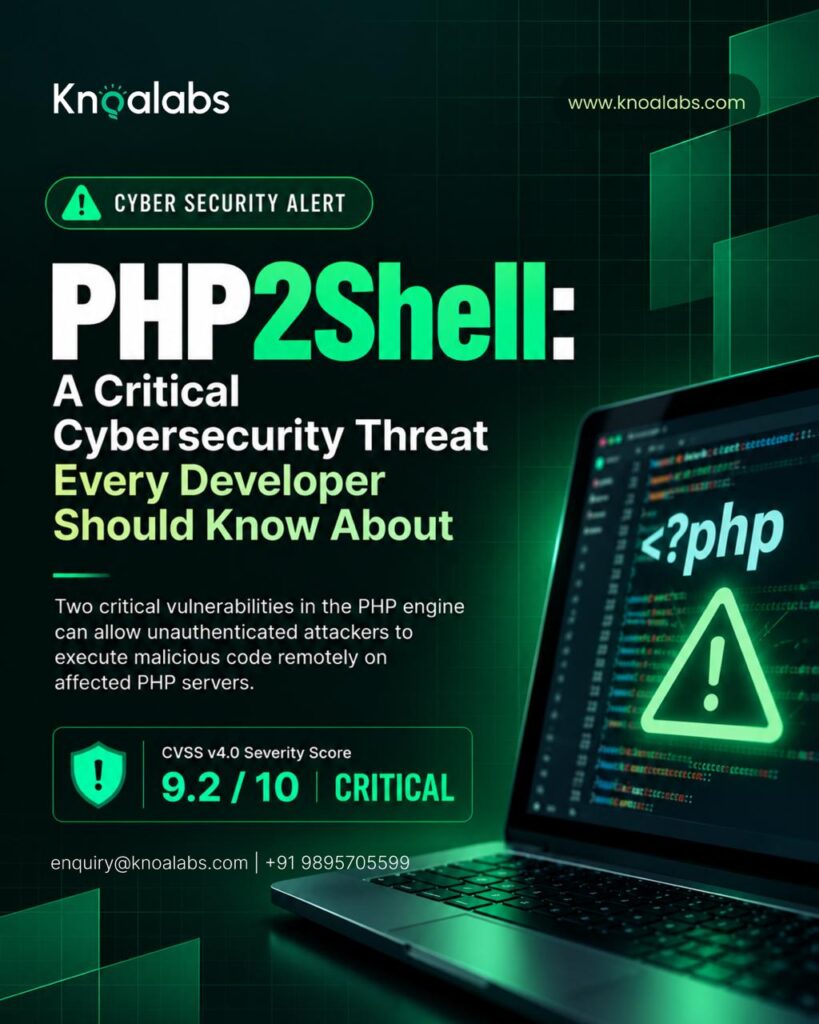
Is your website running PHP? Your server security deserves immediate attention. 🔐
On October 21, 2026, the PHP development team released security updates for two critical vulnerabilities collectively known as PHP2Shell. These flaws can potentially allow unauthenticated attackers to execute malicious code remotely on affected PHP servers.
Both vulnerabilities have a reported CVSS v4.0 severity score of 9.2 out of 10 — Critical. Successful exploitation could put server data, application integrity, and service availability at risk.
🔍 WHAT IS PHP2SHELL?
PHP2Shell refers to two vulnerabilities in the PHP engine itself, rather than a flaw limited to one particular website plugin or application.
🧩 CVE-2026-109618 — Out-of-Memory Corruption
This vulnerability involves PHP’s handling of memory when an out-of-memory condition interrupts an operation. Under certain circumstances, the resulting memory corruption may create a path to remote code execution.
🧩 CVE-2026-109619 — Stale Global State
This vulnerability involves PHP retaining references to memory that has already been released. Subsequent request processing may use that stale state, potentially enabling remote code execution and memory disclosure.
⚠️ WHY IS THIS A SERIOUS RISK?
If successfully exploited, these vulnerabilities may allow attackers to:
🔓 Execute commands on affected servers
📂 Access sensitive files, credentials, or application data
💻 Modify website files or introduce malicious code
🌐 Compromise PHP-powered websites and applications
🚫 Disrupt services and affect business operations
WHO SHOULD CHECK THEIR SYSTEMS?
Organisations and developers operating PHP installations that serve web requests should assess their exposure. This includes environments using PHP-FPM, Apache mod_php, php-cgi, FrankenPHP, and LiteSpeed.
Websites built with platforms such as WordPress, Drupal, and Joomla may also be affected when they run vulnerable PHP versions. The risk depends on the underlying PHP runtime and deployment configuration—not simply the CMS name.
🛡️ HOW TO PROTECT YOUR SERVER
✅ 1. Patch PHP immediately
Upgrade to a fixed, supported release. The PHP project lists these fixed versions:
- PHP 8.5.12
- PHP 8.4.27
- PHP 8.3.36
- PHP 8.2.35
Use the appropriate version for your environment and check your operating system or hosting provider for security-backported packages.
✅ 2. Verify the update
Confirm that the PHP runtime used by your website has actually been updated. Restart relevant workers or services when required.
✅ 3. Review server logs
Investigate unusual requests, unexpected processes, suspicious file changes, unknown administrator accounts, and unexplained outbound connections.
✅ 4. Apply least privilege
Ensure PHP processes and service accounts have only the permissions they need. Restrict access to sensitive files, secrets, and system resources.
✅ 5. Maintain secure backups
Keep isolated or otherwise protected backups and regularly test recovery procedures.
✅ 6. Investigate possible compromise
If you suspect exploitation, contain the affected system, preserve relevant logs, investigate thoroughly, and rotate credentials that may have been exposed.
🚨 IMPORTANT: Updating PHP is the primary and complete fix for these vulnerabilities. Temporary mitigations and firewall rules may reduce exposure but should not replace patching. If an attack may already have occurred, patching alone does not establish that the server is clean.
📌 Save this post for your next security review.
🔁 Share it with your developer or IT team.
💬 Comment below: Is your PHP environment up to date?
Follow Knoa Labs for cybersecurity alerts, technology updates, and industry-focused learning.
Stay informed. Stay prepared. Stay secure. 🔐